
How UK Pay-by-Mobile Casino Deposits Work, Fonix, Boku, and the £30 Cap
You tap pay-by-mobile at the casino cashier, key in your UK mobile number, confirm a one-time SMS PIN, and the charge lands on your next mobile bill or comes straight off your PAYG balance. The whole deposit settles in seconds, and no card or bank details ever reach the casino. Two things catch most first-timers out, so know them before you start: carrier billing is capped at £30 a day, a hard limit Fonix enforces no matter what amount the cashier offers; and the rail is deposit-only, so when you win you cannot withdraw back to your phone bill, and the payout routes to a debit card or bank transfer instead. We deposited a real £10 by Fonix at Ivy Casino in June 2026 and captured every screen, and we checked the deposit method on each operator's own banking page across our register. This is the end-to-end flow: the six steps, the £30/day cap, the SMS PIN, and why withdrawals leave by a different door.
Pay by Mobile: How Do You Make a Deposit?
You use pay by mobile by selecting it at the casino cashier, entering your UK mobile number, and confirming the charge with an SMS PIN. Every UK pay-by-mobile deposit at a UKGC-licensed casino follows the same six-step shape, and in 2026 the rail underneath is always Fonix. The cashier hands the transaction off to a regulated payment institution, the carrier authenticates you by SMS, and the funds settle inside seconds. Here's what's actually happening on each step.
- Nº 01
Open the cashier and choose pay-by-mobile
On a UKGC-licensed casino's deposit screen, you select the pay-by-mobile option. The site routes the request to Fonix, the rail every UK casino on our register now uses.
- Nº 02
Enter your UK mobile number
You type the number tied to your monthly contract or PAYG account. The rail validates the carrier (EE, O2, Three, Vodafone, or a host MVNO) before quoting a deposit amount.
- Nº 03
Pick a deposit amount inside the daily cap
You choose how much to deposit, subject to the £30/day carrier-billing cap and any tighter operator-side or first-deposit ceiling. The minimum is £10 across the pay-by-phone brands we list.
- Nº 04
Receive the SMS PIN
The rail sends a one-time PIN to your handset. The carrier uses this PIN to confirm the number belongs to the person initiating the deposit, not a stolen device.
- Nº 05
Confirm the deposit by entering the PIN
You key the PIN back into the cashier. The carrier authorises the charge against your bill or PAYG balance, the rail confirms to the operator, and the funds settle.
- Nº 06
Funds land in the casino balance
The operator credits the deposit to your gambling balance, typically inside ten seconds. The charge appears on your next mobile bill (or comes off your PAYG balance immediately).
Two details are worth pulling out. First, the SMS PIN sits at step four for a reason: it's the deposit-side authentication that keeps the rail out of the worst kind of mobile-account fraud, and we cover it on its own below. Second, the funds never move through the operator's own banking stack. The carrier owes you the deposit, the rail (Fonix) settles with the operator, and the operator credits your balance. That three-way flow is the same architecture that decides why you can't withdraw the same way, which we get to further down.
Our Documented £10 Fonix Deposit at Ivy Casino, Run in June 2026
We made a real £10 pay-by-mobile deposit at Ivy Casino in June 2026 and captured every screen. The rail was Fonix, the charge was confirmed by a single SMS PIN, and the £10 landed in the balance in seconds. We've blanked our own mobile number; everything else is untouched, including the Fonix order reference. Ivy sets its own ceiling inside the carrier framework: £120 per calendar month on Vodafone, EE, Three and O2, stated right at the cashier. That cashier-stated limit is more specific than the blanket £30 a day figure carriers publish.
-

Step 1 · Lobby Ivy Casino's lobby before we deposited: the balance reads £0.00. -
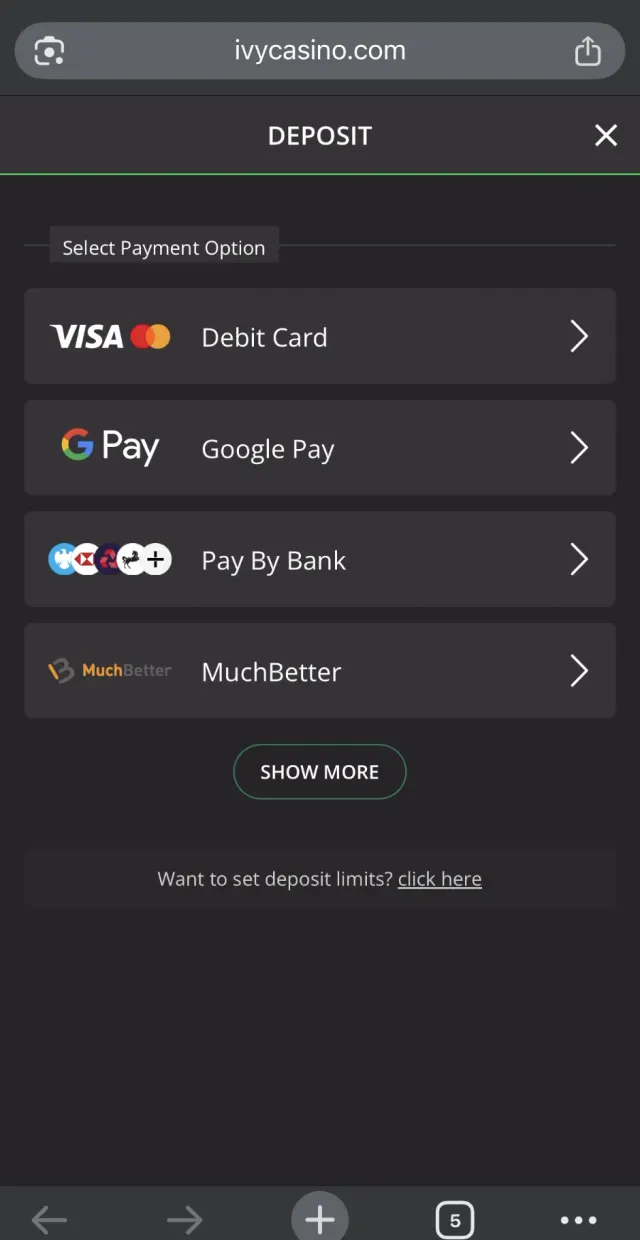
Step 2 · Cashier Opening the cashier shows card, Google Pay, Pay By Bank and MuchBetter first. -
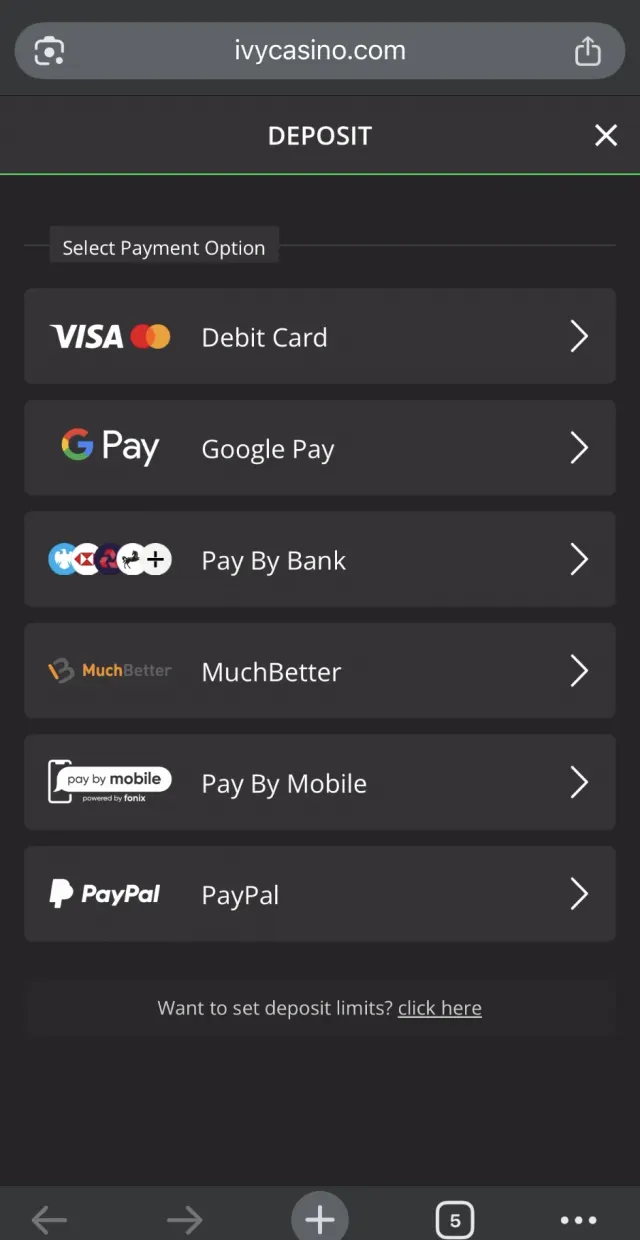
Step 3 · Pay By Mobile Tapping "show more" reveals Pay By Mobile, powered by Fonix. -
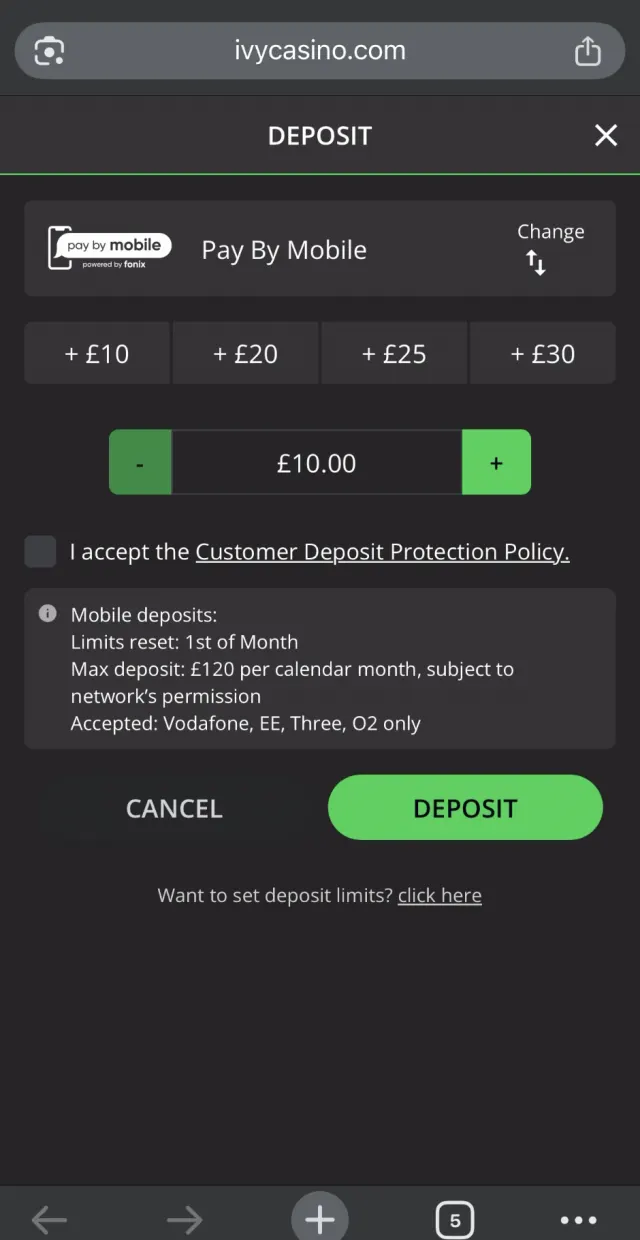
Step 4 · £10 We chose £10. Ivy's cashier states its own limit: £120 per calendar month, on Vodafone, EE, Three and O2 only. -
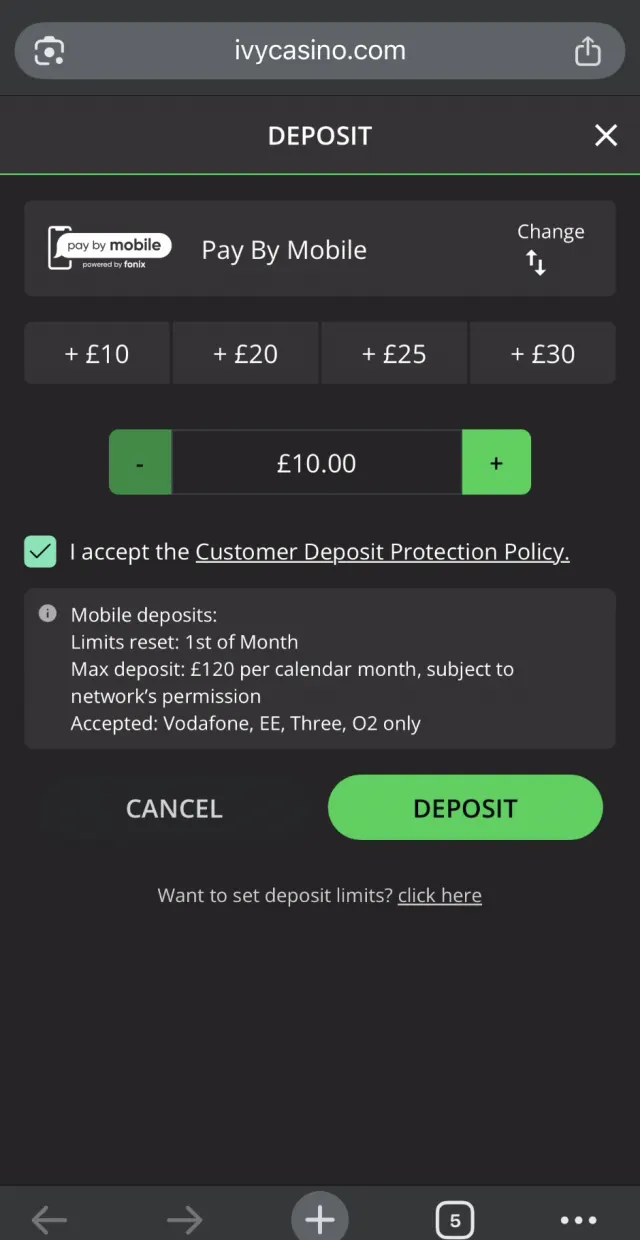
Step 5 · Confirm terms Tick the deposit-protection policy, then tap Deposit. -
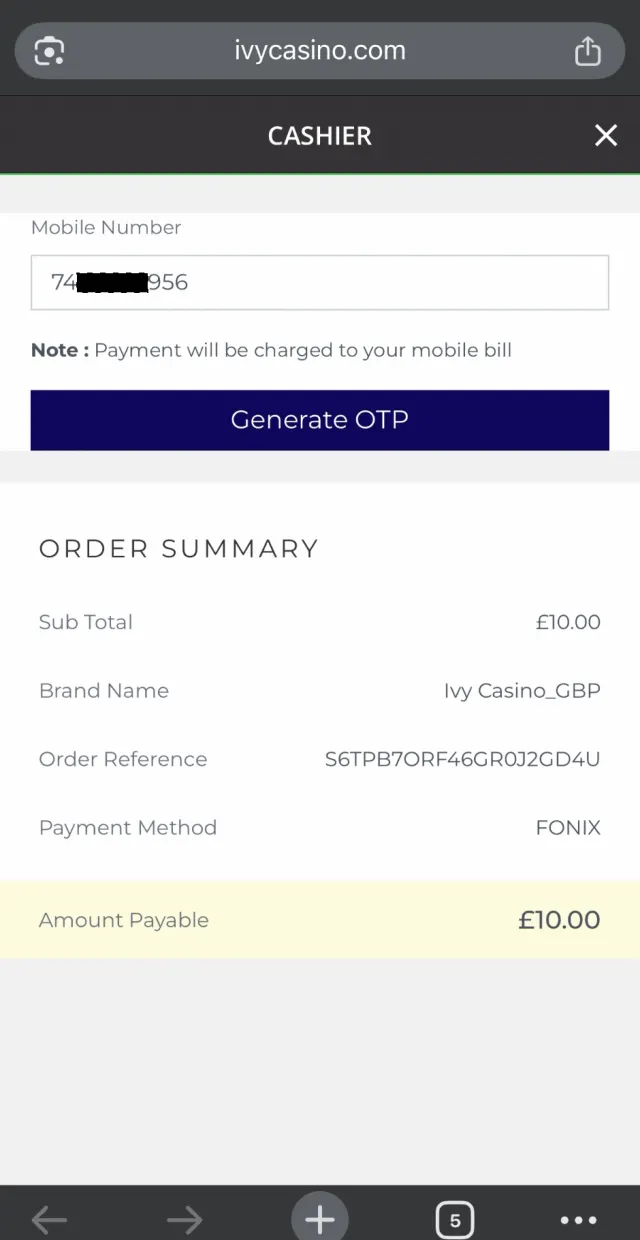
Step 6 · Fonix Enter the mobile number and the order summary names the rail outright: Payment Method FONIX, amount £10. -
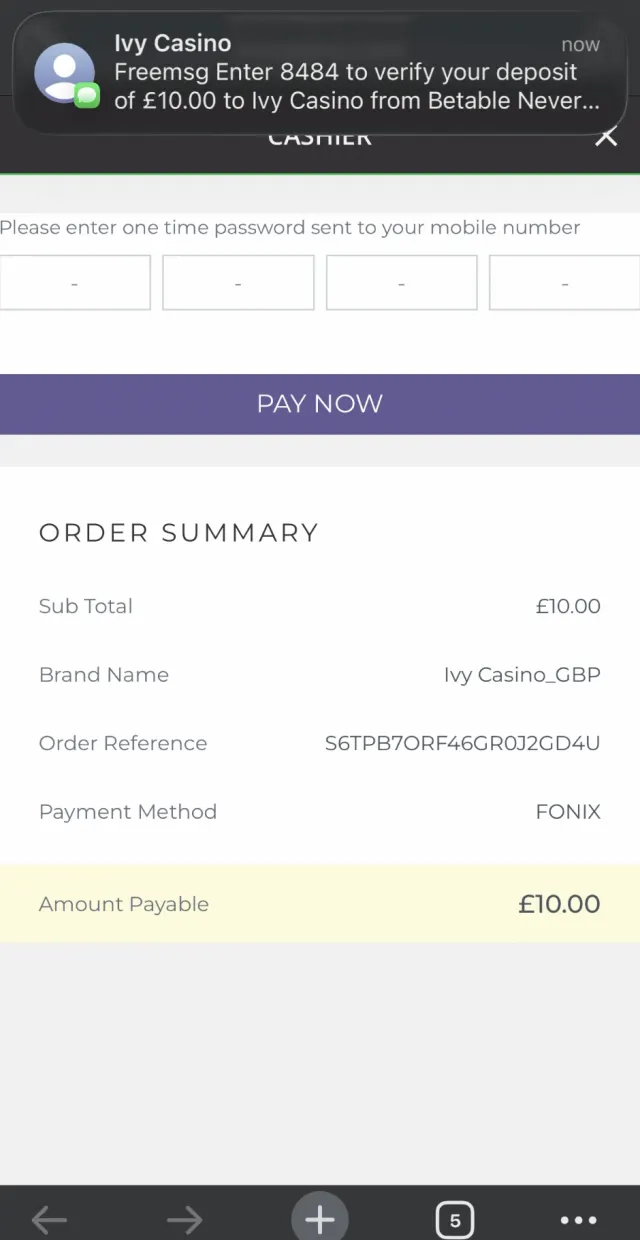
Step 7 · SMS PIN Fonix texts a one-time code (8484). Enter it and tap Pay Now. -
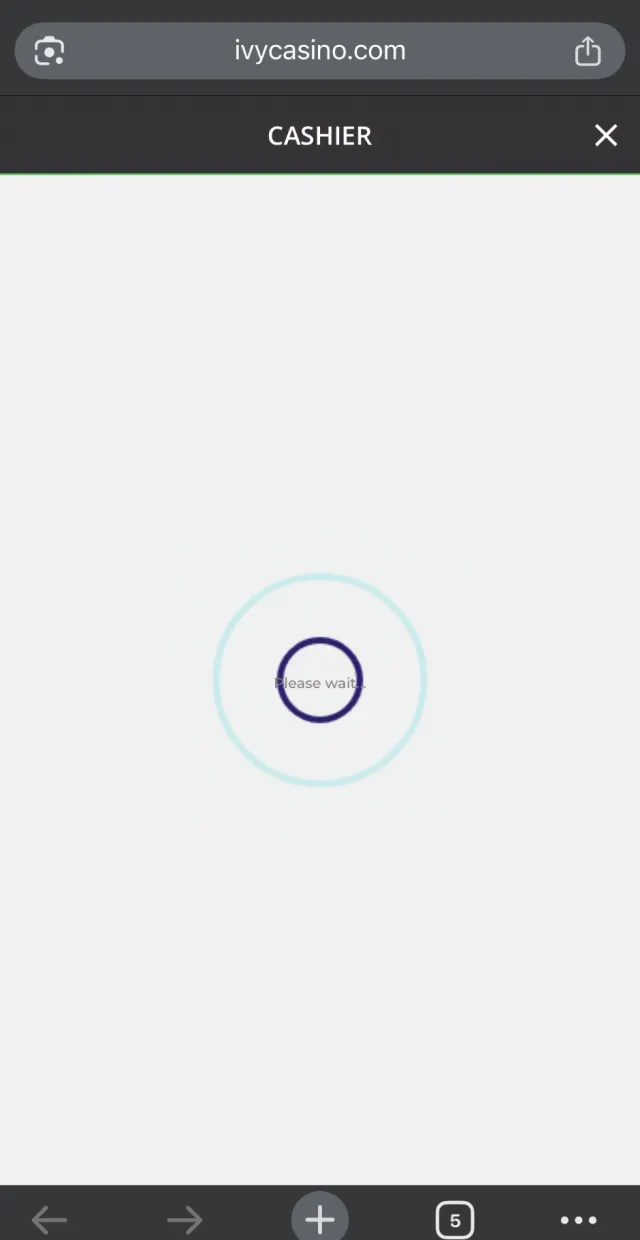
Step 8 · Done The cashier processes the charge and the £10 lands in the balance.
This walkthrough covers one operator on one rail, so other cashiers will lay the screens out differently. The screenshots name the rail (FONIX), the amount (£10) and the brand (Ivy Casino), and the SMS PIN matches the step-four authentication in the six-step process. Ivy Casino is the independent, non-Jumpman brand we rate highest, and it's our editor's pick on the homepage roster.
Fonix Mobile plc, the Dominant 2026 Rail
Fonix Mobile plc is the rail behind most of the pay-by-mobile activity we've audited across UKGC-licensed casinos in 2026. It's a London Stock Exchange-listed AIM company (ticker FNX), headquartered in London. Fonix handles carrier-billing payments across EE, O2, Three, Vodafone, Sky Mobile, and the MVNOs that host on those networks, and its UK gambling-merchant coverage has grown materially since 2023 as Boku has stepped back. When a UKGC casino integrates pay-by-mobile in 2026, Fonix is the rail it usually picks. Payforit, the cross-network carrier-billing scheme UK players once used, has since been retired, and rails such as Siru appear only at operators outside our UKGC register; on the casinos we audit, Fonix is the verified rail.
Here is a regulatory detail no listicle states plainly: neither rail is FCA-authorised, and that is by design, not omission. Carrier billing operates under the Electronic Communications Exclusion of the Payment Services Regulations 2017, which is why the spend limits live at the carrier layer (the £30/day and £240/month caps) rather than under e-money safeguarding rules. Fonix's own AIM admission document states it "is not currently authorised or regulated by the FCA", relying on that exclusion. We've verified, on each operator's own banking page, which UK pay-by-mobile casinos in our directory route through Fonix rather than Boku. For the per-brand breakdown, see the ranked roster on our best pay by phone casinos page, and for a side-by-side view of which rail each operator runs, see the carrier matrix.
Boku Network Services UK Limited, the Rail That Has Left UK Casinos
Boku Network Services UK Limited was, for most of the last decade, the default pay-by-mobile rail at UKGC casinos. It operates under the UK's premium-rate and carrier-billing regime, not under FCA e-money authorisation: the Boku group does hold an FCA-authorised e-money arm (Boku Account Services UK Ltd, firm reference 900030), but that entity ran the group's account products, not casino carrier billing. The £30 daily cap and £240 monthly carrier ceiling that pay-by-phone players know are Boku's, codified into the rail well before they became regulatory expectations.
Boku's UK gambling coverage declined from 2023, and by 2026 the migration is complete. Jumpman Gaming, which operates almost every UK pay-by-phone casino, moved its estate onto Fonix, and no brand on our register now routes through Boku. We aren't speculating on why (Boku Inc.'s own filings flag a strategic re-focus on identity products), but the consequence for a UK player is simple: the rail you meet at the cashier is Fonix, and the £8 first-deposit ceiling Boku once applied went with it. Our Boku casinos UK pillar explains what happened and what to use instead.
The £30/Day Carrier-Billing Cap
The £30/day cap is the single most-misunderstood part of UK pay-by-mobile. It's a cap on how much you can deposit into a UKGC-licensed casino account via carrier billing in any 24-hour period, and it is set and enforced at the carrier-billing layer by Fonix, not by the UKGC. It exists for a reason: UK mobile carrier billing carries hard daily and monthly ceilings on gambling merchants as a problem-gambling control. Boku codified those ceilings at the PSP rail level a decade ago, and Fonix mirrors them now. The 31 October 2025 UKGC mandatory-deposit-limit prompt then layered a separate operator-side limit on top, which we cover on the UK gambling regulation 2026 page.
Two numbers carry the weight. The £30/day cap applies across all UK carriers on the carrier-billing rail. The £240/month carrier ceiling is the longer-window limit (it's roughly eight maxed days a month, not thirty). The old £8 first-deposit ramp-up was a Boku-specific control and left UK casinos when the rail did, so Fonix applies the flat £30 daily cap from your first deposit. We've verified those ceilings against the published operator banking pages in our directory, and the rail-side numbers are the binding ones: even if a casino's UI shows a £50 deposit option, Fonix will refuse the transaction above £30 in a day.
The caps aren't there to be annoying. They're a deliberate problem-gambling tool that puts a hard ceiling on how fast a player can stake-up via the carrier rail, and they're one of the genuine reasons pay-by-mobile is a sensible funding choice for players who want a built-in budget. To layer your own UKGC operator-side deposit limit on top, the UKGC pay-by-phone responsible gambling page walks through the toolkit.
SMS PIN Confirmation
The SMS PIN at step four is the rail's deposit-side authentication. When you key your number into the cashier, Fonix triggers a one-time PIN to your handset, and you have to enter that PIN back into the cashier to authorise the charge. The mechanism is the same shape as the two-factor codes a bank uses, with one difference: the carrier is the authoritative party. The PIN proves the number belongs to the device initiating the deposit, not to a SIM-swap attacker or a stolen handset.
Two practical things to know. First, the one-time PIN from Fonix expires within three minutes, so if you don't enter it promptly you'll need to request a fresh one. Second, the PIN authenticates the deposit, not your casino account itself: the operator still asks for the account-level email-and-password or biometric login at sign-in. The PIN is the bit that proves a real human with a real phone is consenting to a real charge. It's also the part Fonix points to when it argues the rail is fraud-resistant in a way card-not-present deposits aren't.
Pay with Phone Credit: Pay-as-You-Go vs a Monthly Bill
"Pay by phone" and "pay with phone credit" reach the same Fonix rail by two different routes. On a monthly (postpaid) contract the deposit is added to your next bill, exactly as set out above. On pay-as-you-go (PAYG, or prepaid) the same charge is taken straight from the credit balance already on your SIM the moment you confirm the SMS PIN. The cashier flow, the Fonix authentication and the £30/day rail cap are identical either way; the only real difference is whether the money is owed later or spent now.
For PAYG players that distinction matters in one practical way: you can only ever deposit what your credit balance actually holds, so a £10 top-up is a £10 ceiling no matter what the rail's £30 daily allowance permits. There is no overdraft and no bill to settle later, which is exactly why some players treat prepaid credit as a hard spending wall. Carriers gate it differently, though (giffgaff and SMARTY have never enabled gambling charge-to-credit at all), so if a deposit bounces on a prepaid SIM, check the carrier matrix before assuming the casino is at fault.
Pay by Mobile: Can You Withdraw to Your Phone Bill?
No, you can't withdraw using pay by mobile. The rail is deposit-only on UK gambling: a payout can't travel back to your phone bill, full stop. The reason is structural: a mobile carrier can charge a customer (the customer owes the carrier money on the next bill), but a carrier can't pay a customer, because that would turn the rail into a money-remittance service and pull it inside a different chunk of FCA regulation that Fonix is not authorised to operate. So withdrawal asymmetry is the payment-institutional shape of the rail, not an operator quirk.
In practice, that means a withdrawal from a UK pay-by-mobile casino routes to a different method. Debit card (Visa or Mastercard) is the most common alternative, with UK bank transfer (Faster Payments) on many operators and Trustly or Open Banking on a growing minority. Each of those is regulated by the operator's own KYC posture: some brands will let you withdraw to a card you haven't deposited with, most won't, and the standard requirement is that the receiving method is registered in your own name. The responsible-gambling page covers how this interacts with affordability checks, and the carrier matrix lists the alternative withdrawal methods each audited brand actually supports.
One last thing to keep in view. Because deposit and withdrawal use different rails, the timings are different. Pay-by-mobile deposits settle in seconds. Withdrawals to a debit card or UK bank transfer are paced by the operator's KYC review, which varies from same-day on light-touch brands to 48 to 72 hours on standard-posture operators, and sometimes longer where affordability documentation is requested. The asymmetry is the trade-off the rail asks of you: friction-free in, conventional KYC out.
Is There a "No Verification" Pay-by-Phone Casino?
Not a legal one. People search "no verification" because paying by phone genuinely skips the card numbers, bank logins and personal banking details a normal deposit asks for, at the cashier you hand over nothing but a mobile number and an SMS PIN. That friction saving is real, and it is the honest core of the appeal. What it is not is an exemption from Know Your Customer (KYC) checks. Every UKGC-licensed casino is legally required to verify a player's age and identity, and pay-by-phone changes none of that.
The verification simply moves to where the money leaves, not where it enters. You can deposit and play on a frictionless, number-only flow, but the first withdrawal triggers the operator's KYC review, proof of age, identity and, increasingly, affordability, before any payout is released. A site that lets you withdraw with no checks at all is not "light-touch"; it is operating outside the UKGC, which is the "not on GamStop" territory this site deliberately does not cover. If frictionless ID is the goal, the realistic win is completing KYC once, early, on a licensed brand from our roster, not chasing an unlicensed one. The responsible-gambling page explains why those checks exist and how affordability ties in.
Pay by Mobile vs Debit Cards and PayPal
Pay by mobile trades headroom for privacy and a built-in ceiling, and the table below sets the mechanics against the two methods players most often weigh it up with, the debit card and the PayPal-style e-wallet.
| Attribute | Pay by mobile | Debit card | PayPal and e-wallets |
|---|---|---|---|
| Deposit speed | Seconds, confirmed by SMS PIN | Instant | Instant once the wallet account is verified |
| Details shared with the casino | None, only your mobile number | Card number, stored at the operator | No card number, but the deposit is linked to your wallet account |
| Built-in daily cap | £30/day, enforced at the carrier-billing layer | None, limits are operator-set or issuer-set | None, limits are operator-set |
| Fees | £2.50 flat per deposit on the Jumpman estate; none at the Betable trio | Typically free | Typically free |
| Withdrawal support | No, deposit-only | Yes | Yes |
| Bonus eligibility | Qualifies for welcome offers across our roster | Usually eligible | Varies, some welcome offers exclude e-wallet deposits |
The shape of the trade is consistent. Pay by mobile is the only one of the three with a hard spend ceiling inside the rail itself, while debit cards and e-wallets offer per-transaction headroom and a withdrawal route in exchange for putting banking or wallet details into the chain.
Pros and Cons of Paying by Mobile
Four strengths follow directly from the deposit mechanics this page walks through.
- Deposits settle in seconds, with nothing more than an SMS PIN to confirm.
- No card or bank details ever touch the cashier, so a breached operator database holds no card number of yours.
- The £30/day carrier-layer cap acts as a hard, built-in budget ceiling.
- It runs on pay-as-you-go credit as well as monthly contracts.
Four limitations come out of the same carrier-billing architecture.
- The rail is deposit-only, so winnings route back via debit card, bank transfer, or e-wallet.
- A flat £2.50 fee applies per deposit across the Jumpman estate, which is most of our roster; the independent (non-Jumpman) brands charge no deposit fee.
- The £30/day ceiling rules the method out for larger stakes.
- MVNO support varies by network, so some virtual carriers need a cashier check before depositing.